
vim match-up
🔍 screenshot 🔍
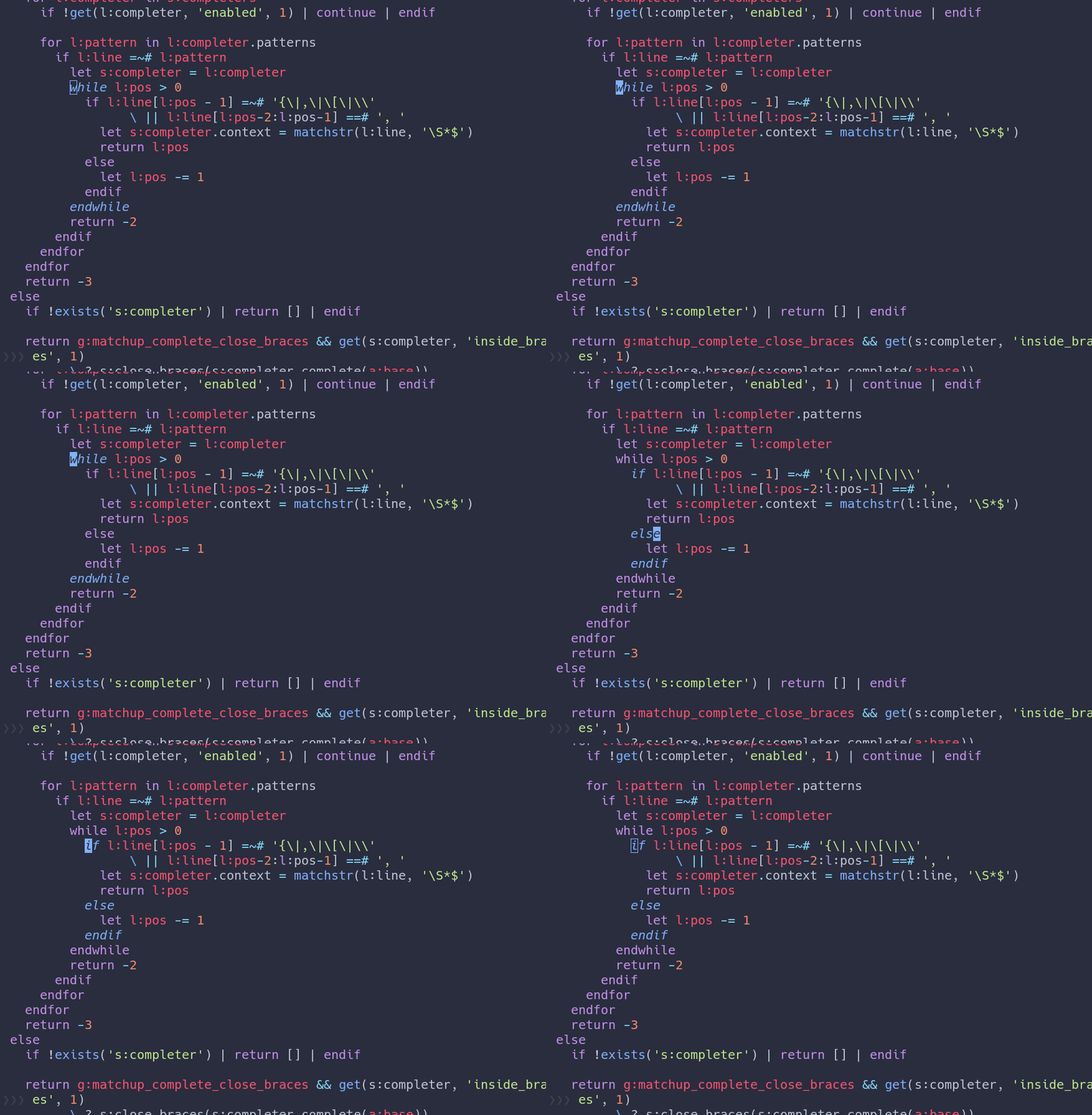
match-up is a replacement for the venerable vim plugin matchit.vim.
match-up aims to replicate all of matchit's features, fix a number of its
deficiencies and bugs, and add a few totally new features. It also
replaces the standard plugin matchparen, allowing all of matchit's words
to be highlighted along with the matchpairs ((){}[]).

A major goal of this project is to keep a modern and modular code base. Contributions are welcome!
Table of contents
Overview
See detailed feature documentation for more information. This plugin:
-
Extends vim's
%motion to language-specific words. The following vim file type plugins currently provide support for match-up:abaqus, ada, aspvbs, c, clojure, cobol, config, context, csc, csh, dtd, dtrace, eiffel, eruby, falcon, fortran, framescript, haml, hamster, hog, html, ishd, j, jsp, kconfig, liquid, lua, make, matlab, mf, mp, ocaml, pascal, pdf, perl, php, plaintex, postscr, ruby, sh, spec, sql, tex, vb, verilog, vhdl, vim, xhtml, xml, zimbu, zsh
Note: match-up uses the same
b:match_wordsas matchit. -
Adds motions
g%,[%,]%, andz%. -
Combines these motions into convenient text objects
i%anda%. -
Highlights symbols and words under the cursor which
%can work on, and highlights matching symbols and words. Now you can easily tell where%will jump to.
Installation
If you use vim-plug, then add the following line to your vimrc file:
Plug 'andymass/vim-matchup'
Or use some other plugin manager:
- vundle
- neobundle
- pathogen
Features
| feature | match-up | matchit | matchparen | |
|---|---|---|---|---|
| (a.1) | jump between matching words | 👍 | 👍 | ❌ |
| (a.2) | jump to open & close words | 👍 | ❓ | ❌ |
| (a.3) | jump inside | 👍 | ❌ | ❌ |
| (b.1) | full set of text objects | 👍 | ❓ | ❌ |
| (c.1) | highlight (), [], & {} |
👍 | ❌ | 👍 |
| (c.2) | highlight all matches | 👍 | ❌ | ❌ |
| (c.3) | display matches off-screen | 👍 | ❌ | ❌ |
| (d.1) | parallel transmutation | 🚧 | ❌ | ❌ |
| (e.1) | modern, modular coding style | 👍 | ❌ | ❌ |
| (e.2) | actively developed | 👍 | ❌ | ❌ |
Legend: 👍 supported. 🚧 TODO, planned, or in progress. ❓ poorly implemented, broken, or uncertain. ❌ not possible.
Detailed feature documentation
What do we mean by open, close, mid? This depends on the specific file
type and is configured through the variable b:match_words. Here are a
couple examples:
vim-script
if l:x == 1
  call one()
else
  call two()
elseif
  call three()
endif
For the vim-script language, match-up understands the words if,
else, elseif, endif and that they form a sequential construct. The
"open" word is if, the "close" word is endif, and the "mid"
words are else and elseif. The if/endif pair is called an
"open-to-close" block and the if/else, else/elsif, and
elseif/endif are called "any" blocks.
C, C++
#if 0
#else
#endif

void some_func() {
    if (true) {
      one();
    } else if (false && false) {
      two();
    } else {
      three();
    }
}
Since in C and C++, blocks are delimited using braces ({ & }),
match-up will recognize { as the open word and } as the close word.
It will ignore the if and else if because they are not defined in
vim's C file type plugin.
On the other hand, match-up will recognize the #if, #else, #endif
preprocessor directives.
(a.1) jump between matching words
%go forwards to next matching word. If at a close word, cycle back to the corresponding open word.{count}%forwards{count}times. Requires{count} <= g:matchup_motion_override_Npercent. For larger{count},{count}%goes to the{count}percentage in the file.g%go backwards to[count]th previous matching word. If at an open word, cycle around to the corresponding close word.
(a.2) jump to open and close words
[%go to[count]th previous outer open word. Allows navigation to the start of blocks surrounding the cursor. This is similar to vim's built-in[(and[{and is an exclusive motion.]%go to[count]th next surrounding close word. This is an exclusive motion.
(a.3) jump inside
z%go to inside[count]th nearest inner contained block. This is an exclusive motion when used with operators, except it eats whitespace. For example, where█is the cursor position,
█ call somefunction(param1, param2)
dz% produces
param1, param2)
but in
█ call somefunction( param1, param2)
dz% also produces
param1, param2)
(b.1) full set of text objects
-
i%the inside of an any block -
1i%the inside of an open-to-close block -
{count}i%If count is greater than 1, the inside of the{count}th surrounding open-to-close block -
a%an any block. -
1a%an open-to-close block. Includes mids but does not include open and close words. -
{count}a%if{count}is greater than 1, the{count}th surrounding open-to-close block.
See here for some examples and important special cases.
(c.1) highlight (), [], and {}
match-up emulates vim's matchparen to highlight the symbols contained
in the matchpairs setting.
(c.2) highlight all matches
To disable match highlighting, let g:matchup_matchparen_enabled = 0.
If this option is set before the plugin is loaded, it will not disable
the built-in matchparen plugin. See here for
other related options.
(c.3) display matches off screen
If a open or close which would have been highlighted is on a line positioned outside the current window, the match is shown in the status line. If both the open and close match are off-screen, the close match is preferred.
(d.1) parallel transmutation
To enable, use let g:matchup_transmute_enabled = 1.
In insert mode, after changing text inside a word, matching words will be changed in parallel. As an example,
<pre>
  text
</pre>
Changing pre to div and leaving insert mode will produce:
<div>
  text
</div>
Note: this currently only works for match words which define a backref
relation like \1.
Parallel transmutation requires the matchparen module to be enabled.
Inclusive and exclusive motions
In vim, character motions following operators (such as d for delete
and c for change) are either inclusive or exclusive. This means
they either include the ending position or not. Here, "ending position"
means the line and column closest to the end of the buffer of the region
swept over by the motion. match-up is designed so that d]% inside a set
of parenthesis behaves exactly like d]), except generalized to words.
Put differently, forward exclusive motions will not include the close
word. In this example, where █ is the cursor position,
if █x | continue | endif
pressing d]% will produce (cursor on the e)
if endif
To include the close word, use either dv]% or vd]%. This is also
compatible with vim's d]) and d]}.
Operators over backward exclusive motions will instead exclude the position the cursor was on before the operator was invoked. For example, in
if █x | continue | endif
pressing d[% will produce
█x | continue | endif
This is compatible with vim's d[( and d[{.
Unlike ]%, % is an inclusive motion. As a special case for the
d (delete) operator, if d% leaves behind lines white-space, they will
be deleted also. In effect, it will be operating line-wise. As an
example, pressing d% will leave behind nothing.
   █(

   )
To operate character-wise in this situation, use dv% or vd%.
This is vim compatible with the built-in d% on matchpairs.
Line-wise operator/text-object combinations
Normally, the text objects i% and a% work character-wise. However,
there are some special cases. For certain operators combined with i%,
under certain conditions, match-up will effectively operate line-wise
instead. For example, in
if condition
 █call one()
  call two()
endif
pressing di% will produce
if condition
endif
even though deleting condition would be suggested by the object i%.
The intention is to make operators more useful in some cases. The
following rules apply:
- The operator must be listed in
g:matchup_text_obj_linewise_operators. By default this isdandy(e.g.,di%andya%). - The outer block must span multiple lines.
- The open and close delimiters must be more than one character long. In
particular,
di%involving a(...)block will not be subject to these special rules.
To prevent this behavior for a particular sequence dvi% or vdi%.
To disable this entirely, remove the operator from the following variable,
let g:matchup_text_obj_linewise_operators = [ 'y' ]
Note: unlike vim's built-in i), ab, etc., i% does not make an
existing visual mode character-wise.
A second special case involves da%. In this example,
    if condition
     █call one()
      call two()
    endif
pressing da% will delete all four lines and leave no white-space. This
is vim compatible with da(, dab, etc.
Options
To disable the plugin entirely,
let g:matchup_enabled = 0
default: 1
To disable a particular module,
let g:matchup_matchparen_enabled = 0
let g:matchup_motion_enabled = 0
let g:matchup_text_obj_enabled = 0
defaults: 1
To enable the experimental transmute module,
let g:matchup_transmute_enabled = 1
default: 0
Variables
match-up understands the following variables from matchit.
b:match_wordsb:match_skipb:match_ignorecase
These are set in the respective ftplugin files. They may not exist for
every file type. To support a new file type, create a file
after/ftplugin/{filetype}.vim which sets them appropriately.
Module matchparen
The matchparen module can be disabled on a per-buffer basis
let b:matchup_matchparen_enabled = 0
default: 1
If this module is disabled on a particular buffer, match-up will still
fall-back to the vim standard plugin matchit, which will highlight
matchpairs such as (), [], & {}. To disable this,
let b:matchup_matchparen_fallback = 0
default: 1
A common usage is to automatically disable matchparen for particular file types;
augroup matchup_matchparen_disable_ft
  autocmd!
  autocmd FileType tex let [b:matchup_matchparen_fallback,
      \ b:matchup_matchparen_enabled] = [0, 0]
augroup END
Whether to highlight known words even if there is no match:
let g:matchup_matchparen_singleton = 1
default: 0
Whether to replace the statusline for off-screen matches:
let g:matchup_matchparen_status_offscreen = 0
default: 1
highlighting timeouts
Adjust timeouts in milliseconds for matchparen highlighting:
let g:matchup_matchparen_timeout = 300
let g:matchup_matchparen_insert_timeout = 60
default: 300, 60
deferred highlighting
Deferred highlighting improves cursor movement performance (for example,
when using hjkl) by delaying highlighting for a short time and waiting
to see if the cursor continues moving;
let g:matchup_matchparen_deferred = 1
default: 0 (disabled)
Adjust timeouts in milliseconds for deferred highlighting:
let g:matchparen_matchparen_deferred_show_time = 50
let g:matchparen_matchparen_deferred_hide_time = 700
default: 50, 700
highlight surrounding
To highlight the surrounding delimiters until the cursor moves, use a map such as the following
nmap <silent> <F7> <plug>(matchup-hi-surround)
There is no default map for this feature.
Module motion
In vim, {count}% goes to the {count} percentage in the file.
match-up overrides this motion for small {count} (by default, anything
less than 7). To allow {count}% for {count} up to 11,
g:matchup_motion_override_Npercent = 11
To disable this feature, and restore vim's default {count}%,
g:matchup_motion_override_Npercent = 0
default: 6
If enabled, cursor will land on the end of mid and close words while
moving downwards (%/]%). While moving upwards (g%, [%) the cursor
will land on the beginning. To disable,
let g:matchup_motion_cursor_end = 0
default: 1
Module text_obj
Modify the set of operators which may operate line-wise
let g:matchup_text_obj_linewise_operators' = ['d', 'y']
default: ['d', 'y']
Module transmute
Options planned.
FAQ
-
match-up doesn't work
This plugin requires at least vim 7.4. It should work in vim 7.4.898 but at least vim 7.4.1689 is better. I recommend using the most recent version of vim if possible.
If you have issues, please tell me your vim version and error messages. Try updating vim and see if the problem persists.
-
Why does jumping not work for construct X in language Y?
Please open a new issue
-
Highlighting is not correct for construct X
match-up uses matchit's filetype-specific data, which may not give enough information to create proper highlights. To fix this, you may need to modify
b:match_words.For help, please open a new issue and be a specific as possible.
-
I'm having performance problems
match-up aims to be as fast as possible, but highlighting matching words can be intensive and may be slow on less powerful machines. There are a few things you can try to improve performance:
- Update to a recent version of vim. Newer versions are faster, more extensively tested, and better supported by match-up.
- Try deferred highlighting, which delays highlighting until the cursor is stationary to improve cursor movement performance.
- Lower the highlighting timeouts. Note that if highlighting takes longer than the timeout, highlighting will not be attempted again until the cursor moves.
If are having any other performance issues, please open a new issue and report
g:matchup#perf#times. -
How can I contribute?
Read the contribution guidelines and issue template. Be as precise and detailed as possible when submitting issues and pull requests.
Interoperability
- match-up's match highlighting is not compatible with vimtex's implementation. match-up highlighting and will be disabled automatically when vimtex is detected.
- matchit.vim should not be loaded. If it is loaded, it must be loaded after match-up (in this case, matchit.vim will be disabled). Note that some plugins, such as vim-sensible, load matchit.vim so these must also be initialized after match-up.
- match-up loads matchparen if it is not already loaded.
Acknowledgments
Origins
match-up was originally based on @lervag's vimtex. The concept and style of this plugin and its development are heavily influenced by vimtex. 🍻
Other inspirations
- matchit
- matchparen
- MatchTag
- MatchTagAlways
- vim-endwise
- auto-pairs
- delimitMate
- splitjoin.vim
- vim-surround
- vim-sandwich
Development
Reporting problems
This is a brand new plugin and there are likely to be many bugs. Thorough issue reports are encouraged. Please read the issue template first. Be as precise and detailed as possible when submitting issues.
Feature requests are also welcome.
Contributing
Please read the contribution guidelines before contributing.
Todo list
- thoroughly test with unicode, tabs
- complete parallel transmutation in an efficient way.
- add screenshots and animations
- support for fenced code possible?
- add file type
quirksmodule - investigate whether
&selection/&virtualeditoptions are important - can match-up be integrated with vim-surround?
- support python (like python_match.vim)